Please wait while we open this resource.


K

Clinical reviews
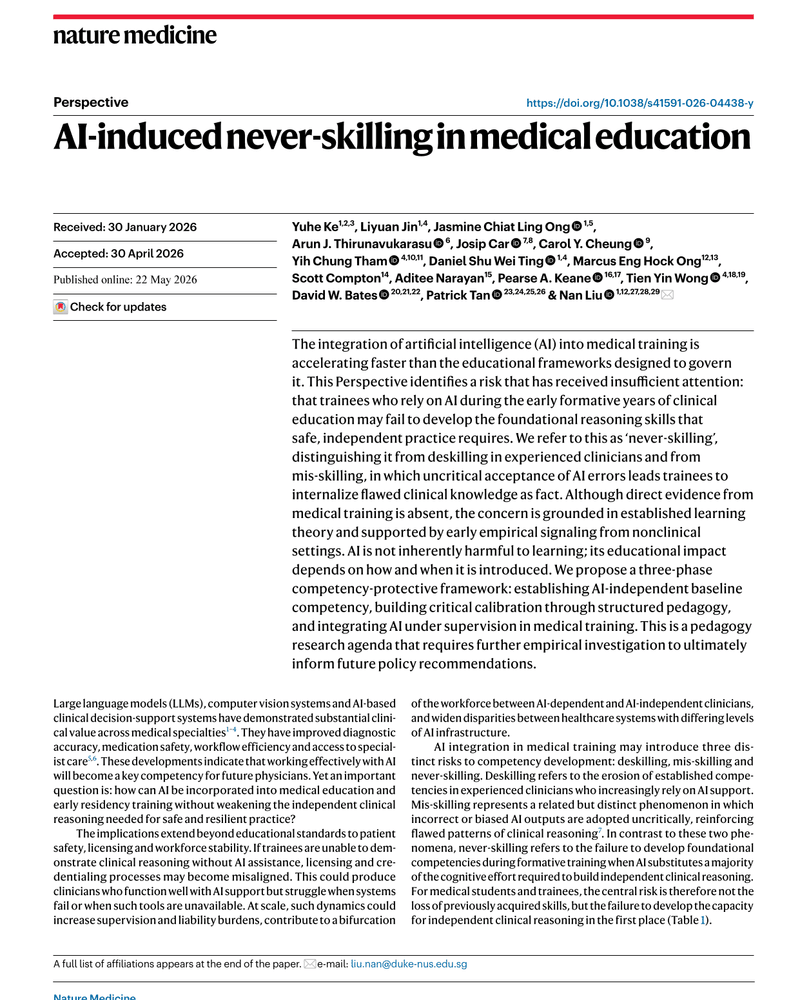
AI-INDUCED NEVER-SKILLING IN MEDICAL EDUCATION
Duke-NUS Medical School, National University of Singapore, Harvard Medical School, and others
PDF202610 pages813 KB
The integration of artificial intelligence (AI) into medical training is accelerating faster than the educational frameworks designed to govern it. The document discusses the potential negative impact of AI on the development of essential clinical reasoning skills among medical trainees. It highlights the importance of designing assessment tasks that reveal AI-independent competency and suggests that the educational impact of AI depends on how and when it is introduced into training. The authors call for collaboration between AI developers and clinical experts to create realistic training scenarios that prepare trainees for real-world clinical challenges.
Sign in to open
Ask this resource
Answers use this document only.
Your first question is free.
More like this
Resources from the same specialty and type. Curated links will replace these when added.
Clinical Resources
Documents that extend or complement this resource.

Enhancing Employee Motivation Strategies
Same specialty · Medical Education
Manuscript writing workshop
Same specialty · Medical Education
Busitema University Human Resource Manual 2020
Same specialty · Medical Education

Doctoral Research Foundations and Philosophical Assumptions
Same specialty · Medical Education
Traumatic Brain Injury
Same resource type · Neurology
ADA Consensus Report: MASLD in People With Diabetes
Same resource type · Endocrinology
Hospital Care for Children Guidelines
Same resource type · Pediatrics
Management of Obesity
Same resource type
Classification of the Epilepsies
Same resource type · Neurology