Preparing your experience, please wait…


K

Clinical notes
small hutch 2 (2)
Internal Medicine
PDF96 pages31.8 MB
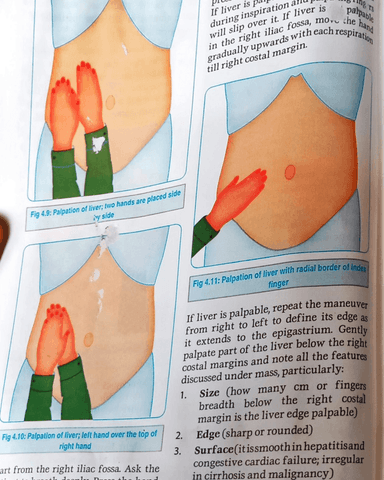
The excerpts describe essential bedside examination methods for assessing the abdomen and neurological functions. For abdominal examination, it details the palpation of the liver, including its size, edge, surface, consistency, tenderness, and pulsations, along with common causes of hepatomegaly and tender hepatomegaly. It also differentiates between ascites and ovarian cysts and discusses the significance of bowel sounds and succussion splashes. Neurologically, it outlines the corticospinal tract, its pathways from the cerebral cortex to the spinal cord, and the components of the extrapyramidal system involved in movement and posture. The spinal cord's extent and segmentation are also described.
No account needed
Discuss clinical evidence & guidelines
Examine in Ask OslerAsk this resource
Answers from this document onlyName jerky nystagmus by its fast phase
“Jerky nystagmus: Oscillations are quick in one direction and slow in the other direction. Direction of nystagmus is named after the direction of the quick component.”
More like this
Resources from the same specialty and type. Curated links will replace these when added.
Clinical Resources
Documents that extend or complement this resource.
Oxford Handbook of Clinical Medicine 11E 2024
Same clinical topic · Internal Medicine
Step-Up to Surgery 2nd Edition PDF
Same clinical topic · Internal Medicine
Macleods Clinical Examination 14th Edition
Same clinical topic · Internal Medicine
Davidson's Essentials of Medicine 3rd Edition 2021
Same clinical topic · Internal Medicine
Cecil Essentials of Medicine (1)
Same clinical topic · Internal Medicine
THE OSCE MEDICAL REFERENCE POCKET GUIDE 2024
Same clinical topic · Internal Medicine
Medicine for MRCP-Oxford University (2020)
Same clinical topic · Internal Medicine
LMSA INTERNAL MEDICINE [MakMED] Copy (2)
Same clinical topic · Internal Medicine
Differential Diagnosis in Clinical Medicine
Same clinical topic · Internal Medicine