Please wait while we open this resource.


K

Clinical reviews
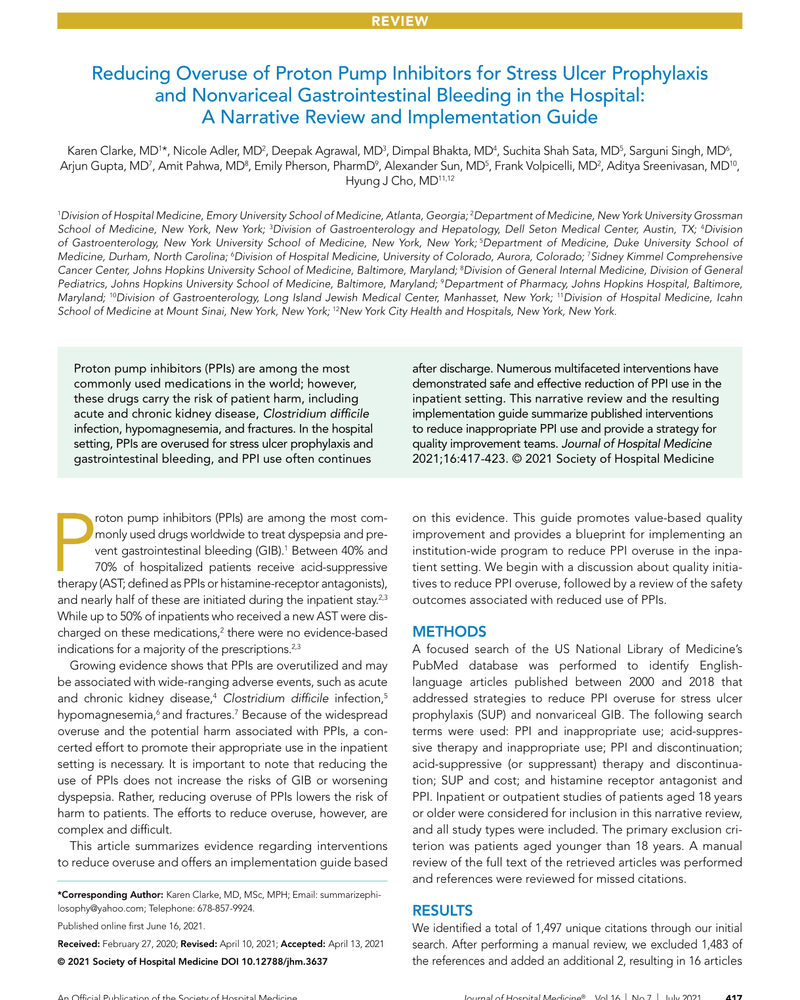
Reducing Overuse of Proton Pump Inhibitors for Stress Ulcer Prophylaxis and Nonvariceal Gastrointestinal Bleeding in the Hospital: A Narrative Review and Implementation Guide
Emory University School of Medicine
PDF7 pages101 KB
Proton pump inhibitors (PPIs) are commonly prescribed in hospitals, often leading to unnecessary patient risks such as kidney disease and infections. This narrative review highlights the prevalence of inappropriate PPI use for stress ulcer prophylaxis and discusses the outcomes of various interventions aimed at reducing such practices. The authors emphasize the need for clinician education and monitoring to ensure appropriate use and to mitigate potential adverse effects associated with PPI therapy.
Sign in to open
Ask this resource
Answers use this document only.
Your first question is free.
More like this
Resources from the same specialty and type. Curated links will replace these when added.
Clinical Resources
Documents that extend or complement this resource.
ACUTE PANCREATITIS: MECHANISMS AND THERAPEUTIC APPROACHES
Same clinical topic · Gastroenterology
Functional Dyspepsia
Same clinical topic · Gastroenterology
AGA CLINICAL PRACTICE UPDATE ON EVALUATION AND MANAGEMENT OF REFRACTORY CONSTIPATION: EXPERT REVIEW
Same clinical topic · Gastroenterology
AGA CLINICAL PRACTICE UPDATE ON MANAGEMENT OF CLOSTRIDIOIDES DIFFICILE INFECTION IN ADULTS: EXPERT REVIEW
Same clinical topic · Gastroenterology
CURRENT APPROACH TO DIAGNOSIS AND MANAGEMENT OF LOW-PHOSPHOLIPID ASSOCIATED CHOLELITHIASIS SYNDROME
Same clinical topic · Gastroenterology
PRIMER Ulcerative colitis
Same clinical topic · Gastroenterology
PRIMER CROHN’S DISEASE
Same clinical topic · Gastroenterology
UNCOMPLICATED CHOLEDOCHOLITHIASIS IN ELDERLY PATIENTS: A TARGET TRIAL EMULATION COMPARING OBSERVATION AND ENDOSCOPIC RETROGRADE CHOLANGIOPANCREATOGRAPHY
Same clinical topic · Gastroenterology
CELIAC DISEASE
Same clinical topic · Gastroenterology